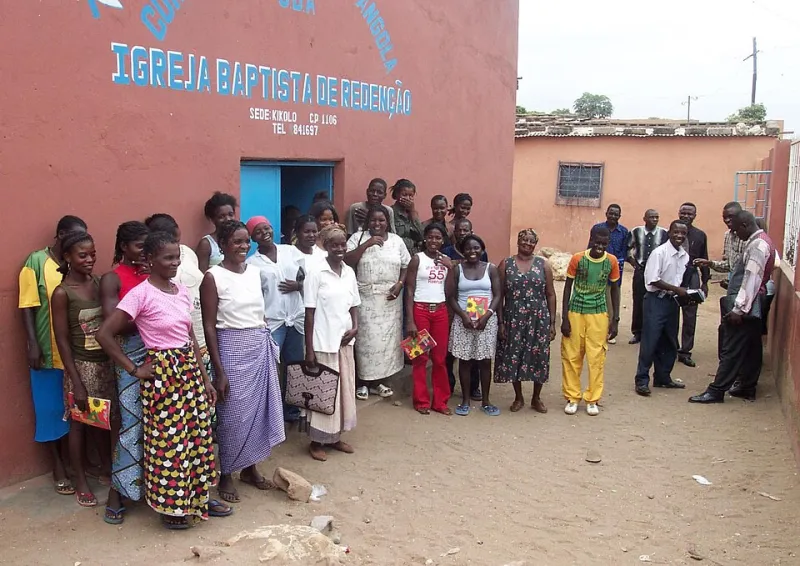
Sunday Service, Served by Airtable: Inside the Congregations Quietly Out-Automating Everyone
Here's a stat nobody in the no-code world talks about: some of the most sophisticated Airtable bases in America are maintained by volunteers who show up to committee meetings in their Sunday best.
Faith communities have always been operationally complex. A mid-size congregation is essentially a small nonprofit, an event venue, a school, and a food bank stacked on top of each other — usually run by two paid staff members and a rotating cast of retirees with Excel opinions. What's changed in the last few years is that instead of suffering through it, many of these communities started building their way out.
The Rural Baptist Church With a Donor Database Better Than Yours
Take Mount Gilead Baptist, a congregation of about 120 in rural Georgia. Their volunteer scheduler was, until 2022, a literal spiral notebook that lived in the church office. When the notebook got water damage from a leaky roof, so did the record of who was supposed to run the soundboard the following Sunday.
Enter Sister Delores — not a developer, not a tech worker, just a retired school administrative assistant who "watched a YouTube video and got stubborn about it." She rebuilt the entire operation in Airtable: volunteer rotations, choir schedules, a pastoral care log tracking which members hadn't been seen in a while (flagged gently, she emphasizes, as "check-in" not "surveillance").
Her total spend? Free tier for eight months, then about $20 a month. The church had budgeted $4,000 for an "office management system" from a vendor. That money bought the new roof instead.
Why Faith Communities Are the Perfect No-Code Storm
The pattern shows up everywhere once you look. Three conditions make congregations ideal adopters:
Tiny budgets, huge admin loads. There's no money for custom software, but there IS a burning need to track 300 member households, quarterly giving statements, and who's bringing the casserole to the Shiva.
Trust-based data. Churches run on relationships. A relational database is a genuinely natural fit for an organization where the core asset is literally community.
Volunteer turnover. Every congregation bleeds volunteers every August. Systems that live in one person's head die with their term as chair. Documented no-code systems survive the transition.
A suburban synagogue outside Cleveland ran into this exact problem. Their membership records lived in a beloved but aging Access database maintained by one man, Marty, who was — with all respect — planning to retire. The temple's answer was a two-month migration to a no-code membership platform, run by a committee of three people whose combined technical training was one community college course. They now run giving statements, event RSVPs, religious school registration, and their high holiday ticketing from a single dashboard.
The Megachurch Playbook
At the other end of the spectrum sits a 2,000-member church in the Dallas suburbs that operates more like a logistics company. Their operations director — a former supply chain manager — described their stack to me like he was briefing a board: a membership CRM, automated check-in kiosks for the kids' ministry, a volunteer management system covering 400 weekly volunteers, and a facilities scheduling tool that coordinates the building across five ministries.
The punchline? Roughly 80% of it is no-code, assembled from tools like Planning Center, Zapier, and a custom Airtable front end. The church employs zero developers. When they priced the equivalent custom build, quotes came back between $60,000 and $120,000.
"We don't have a software problem anymore," he told me. "We have a training problem, and training is cheap."
What Any Small Organization Can Steal
You don't need to be a congregation to benefit from what these groups figured out. The transferable lessons:
Assign an owner, not a committee. Every successful system we saw had one Delores — a named person with authority to change fields and delete duplicates. Committees build software the way they plan potlucks: slowly and with too many casseroles.
Start with the most painful spreadsheet, not the most important system. The synagogues didn't begin with membership. They began with the Yom Kippur ticket spreadsheet everyone hated. One win bought buy-in for everything else.
Plan for the handoff before you build. The best congregations document their bases like they're expecting to be hit by a bus — because their volunteers, eventually, always are.
Respect the data's emotional weight. A donor record at a small church isn't a CRM entry; it's Mrs. Whitfield, who gave every Sunday for 40 years. The best faith-based builders design their systems with that humanity baked in — notes fields, care flags, gentle automations.
There's something fitting about all of this. Institutions built entirely on the labor of unpaid believers turn out to be naturals for tools that let unpaid believers build software. The steeple doesn't need a developer. It needs one stubborn person with a free afternoon and a YouTube tab open.
Ask around your own town. The odds are good there's already a Delores at work.