Whoever Owns the Dashboard Owns the Neighborhood: A Cautionary Tale From the cul-de-sac
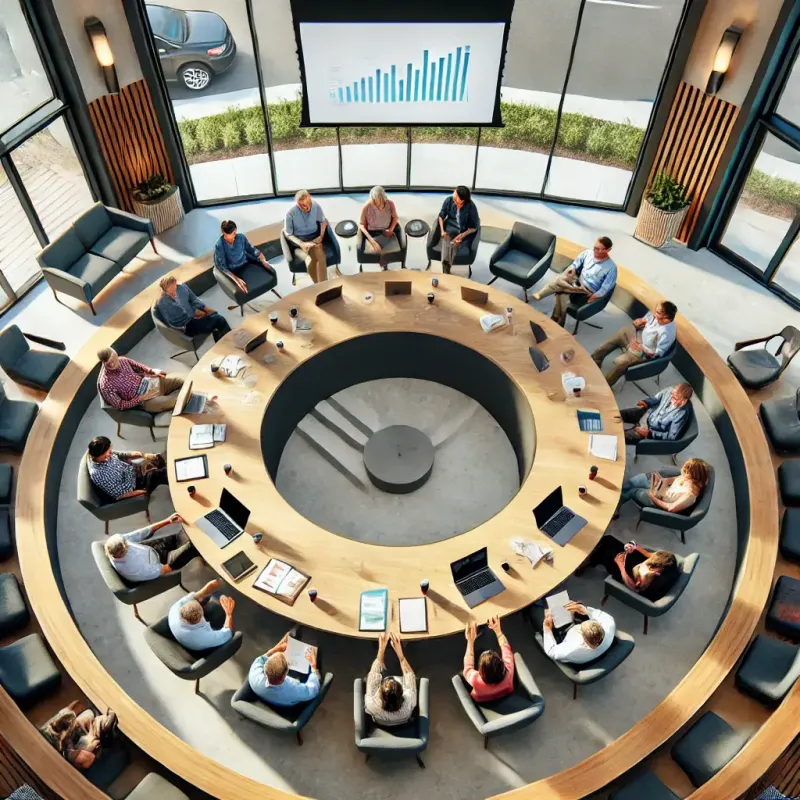
Photo: suburban homeowners association board meeting in living room laptop, via beaconcommunitymanagement.com
The Most Powerful Login in Suburbia
When Dave Kellerman retired from a logistics job in Columbus, he did what a lot of handy volunteers do: he took over his homeowners association's paperwork. Dues tracking in Airtable. Violation photos logged through a Glide app. Automated reminders pinging the board's Gmail the moment a lawn inspection report got submitted.
It was, by every account, a huge improvement. Meetings got shorter. Dues collection jumped. The annual budget finally balanced.
Then it got weird.
"I realized one night that I could see everything," Kellerman told me, laughing but not entirely laughing. "Every complaint. Every board email thread. The violation history for every house — including the board members' houses. And nobody else had the login."
What Accountability Looks Like When It's One Airtable Seat
Here's the thing about no-code tools: they're built for speed and simplicity, not for institutional checks and balances. When a single volunteer spins up the stack, that volunteer becomes the system. They hold the credentials, they shape the data model, and — deliberately or not — they decide what gets surfaced and what stays buried.
Dr. Marisol Vega, who studies local governance at a Midwest public university, says this is more common than anyone admits. "HOAs are already lightly regulated in most states," she explains. "When the record-keeping lives in one person's personal account, you've essentially privatized the association's memory. If that person has a grudge, or just bad judgment, there's no audit trail anyone can independently access."
In Kellerman's case, things came to a head over a disputed fence violation against a board member. The violation existed in the database. It also happened to be flagged, timestamped, and escalated by automations Kellerman himself had configured. Whether that was neutral enforcement or a power play depended entirely on who you asked at the spring meeting — a meeting that got heated enough that two members suggested Kellerman "step back from the tools."
He did. Sort of. He handed over the logins. But the automations kept breaking, because — as anyone who's inherited someone else's Zapier account knows — the documentation lived in his head.
The Coup Nobody Had to Stage
I'm calling it a coup half as a joke. Nobody seized power at gunpoint in a cul-de-sac in Ohio. But strip away the drama and the mechanics are the same as any institutional takeover: control the information, control the decisions. The board president technically still had the title. Kellerman had the dashboards. Guess whose version of reality carried the day in every argument?
This isn't unique to HOAs. We've covered church directories, youth sports leagues, and volunteer fire departments running on the same pattern: one enthusiastic builder, one invisible stack, zero succession plan. The tools make building so easy that governance — boring old bylaws about record access and data ownership — never catches up.
What the Experts Say to Do Instead
Vega's advice for any community group going no-code is refreshingly unglamorous:
- Put the accounts in the organization's name, not a person's. Use a shared email like [email protected] as the account owner.
- Write the access rules down. Who can view violation records? Who can edit the budget? Put it in the minutes.
- Export quarterly. A CSV backup in a shared drive is the digital equivalent of a locked records cabinet.
- Assume the builder will leave. Because they always do. People move, lose interest, or win the argument they were having.
Kellerman, for his part, says he'd do it all again — just differently. "I genuinely thought I was helping," he told me. "And mostly I was. But if I could go back, I'd hand the president a read-only view on day one and let somebody else hold a second set of keys."
The neighborhood, meanwhile, still runs on his stack. Two board members split the logins now. The fence dispute got resolved. And Kellerman has moved on to a new project: automating the snack schedule at his granddaughter's soccer league.
Pray for the snack schedule.